LS Lindquist Steels — Tool Steel & Specialty Materials Division
Home  /  Products  /  Tool Steel  /  H13
/ Hot-Work · Cr-Mo-V · Air-Hardening

H13 Hot-Work Tool Steel

The benchmark Cr-Mo-V hot-work tool steel. Used wherever steel meets aluminum at heat: die-casting dies, hot forging dies, extrusion tooling, plastic mold cavities for high-temperature resins.

AISI H-13 · UNS T20813 · Lindquist code TBBH97

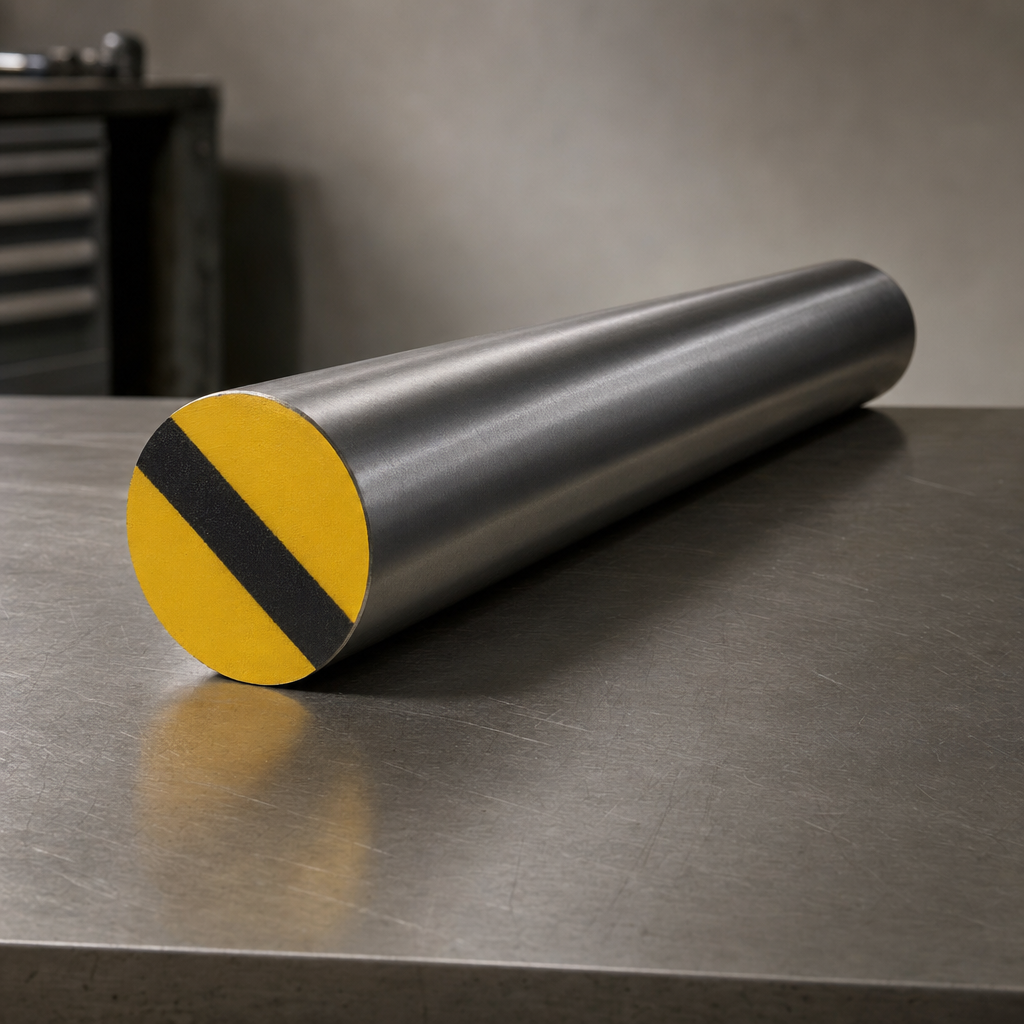
H13 hot-work tool-steel round bar with painted yellow-with-black-stripe color-code end.
/ At a glance
Type
Hot-Work · Cr-Mo-V · Air-Hardening
Hardness
HRC 38–48 (44–48 die-cast)
Anneal BHN
BHN 207 max
Color code
Yellow / Black stripe
Forms
Plate, Block, Round, Drill Rod
Designation
AISI H-13
/ Typical applications
Aluminum die-cast dies Zinc die-cast dies Hot forging dies Extrusion tooling Mandrels Hot shears Plastic mold (high-temp) Press tooling
/ Chemical composition (%)
CCrSiMoV
0.405.251.001.251.05
/ Characteristics
Machinability75 (vs 1% C steel = 100)
Dimensional stability+0.001 in/in expansion on air-quench
Critical points (heating)Ac 1600–1665°F
Critical points (cooling)Ar 1460–1350°F
Surface chemistrySensitive to carb/decarb — vacuum or stainless-foil wrap during heat-treat

Heat treatment.

Forge, anneal, harden, temper. The full cycle as published in the Lindquist code TBBH97 technical bulletin.
/ Heat-treat cycle
Forging2050–2150°F, stop at 1650°F, cool slowly
Annealing1600°F, furnace-cool · BHN 207 max
Preheat1350°F (soak)
Hardening1850°F, air-quench
Tempering1050–1150°F → HRC 38/46 · die-cast 1100°F → HRC 44/48
/ Tempering — hardness chart
Temper °FRockwell C
40054
50053
60053
70053
80053
90054
100052
110046
120036

→ Air-quenched from 1850°F, 2-hr temper. All hot-work steel should be tempered at least 50°F above expected operating temperature. Double tempering advised when heat-checking is a concern.

/ Customers cross-shop H13 with

Need H13 on your dock?

We stock H13 in plate, block, round, drill rod. Tell us the size and quantity — we'll come back with a price and a date.

Datasheet content reproduced from Lindquist technical bulletin Lindquist code TBBH97. Heat-treatment recommendations are typical — confirm specifics with your metallurgist for production work.