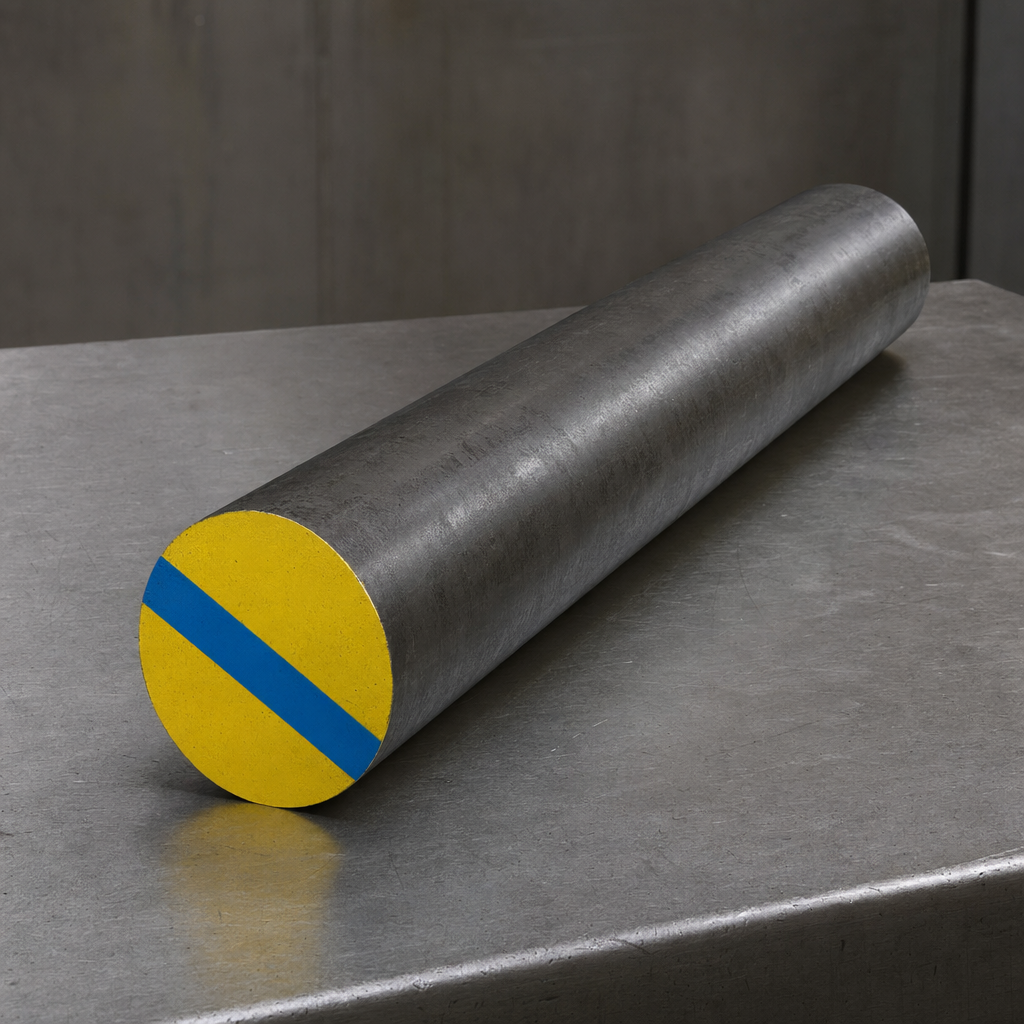
The shock-resisting tool steel. Where impact loading would crack a higher-hardness die, S7 takes the hit — pneumatic chisels, riveting tools, masonry drills, structural punches, large plastic-mold cavities that can't be liquid-quenched.
AISI S7 · UNS T41907 · Lindquist code TBS797

| C | Cr | Mo | Mn | Si |
|---|---|---|---|---|
| 0.50 | 3.25 | 1.40 | 0.70 | 0.25 |
| Machinability | 95 (vs 1% C steel = 100) |
|---|---|
| Dimensional stability | +0.001 in/in expansion on air-quench |
| Tensile strength @ 400°F temper | >300,000 psi (HRC 58) |
| Charpy impact @ 400°F temper | 180 ft-lb (unnotched) |
| Forging | Preheat 1200–1300°F, forge 2000–2050°F, stop 1700°F |
|---|---|
| Normalizing | Do not normalize |
| Annealing | 1500–1550°F, slow-cool to 1000°F, air · BHN 197 max |
| Preheat | 1200–1300°F |
| Hardening | 1725°F · air ≤2½″ section · oil-then-air for 2½–6″ |
| Tempering | 400°F minimum · double-temper oil-quenched parts |
| Temper °F | Rockwell C | Unnotched Charpy (ft-lb) |
|---|---|---|
| As Quenched | 60 | — |
| 300 | 59 | — |
| 400 | 58 | 180 |
| 500 | 56 | 227 |
| 600 | 55 | 228 |
| 700 | 54 | 199 |
| 800 | 53 | 179 |
| 900 | 52 | 190 |
| 1000 | 51 | 239 |
| 1100 | 47 | 264 (no break) |
| 1200 | 39 | 264 (no break) |
| 1300 | 33 | 264 (no break) |
→ Charpy values marked "no break" hit the machine's measurement ceiling. For hot-work apps temper 900–1000°F; for cold-work 400–500°F. Never temper below 400°F.
Heat-treating large plastic molds (>6″ section): use air-quench + 400°F temper to avoid stress cracking — typically yields HRC 50/54 with little practical service-life difference vs. higher-hardness range.
A general-purpose, air-hardening, medium-alloy cold-work tool steel with excellent dimensional stability, good wear resistance, and the ease of heat treatment that has made it the workhorse of the cold-work category.
The benchmark Cr-Mo-V hot-work tool steel.
The most widely used high-speed steel.
We stock S7 in plate, block, round, groundstock, drill rod. Tell us the size and quantity — we'll come back with a price and a date.
Datasheet content reproduced from Lindquist technical bulletin Lindquist code TBS797. Heat-treatment recommendations are typical — confirm specifics with your metallurgist for production work.